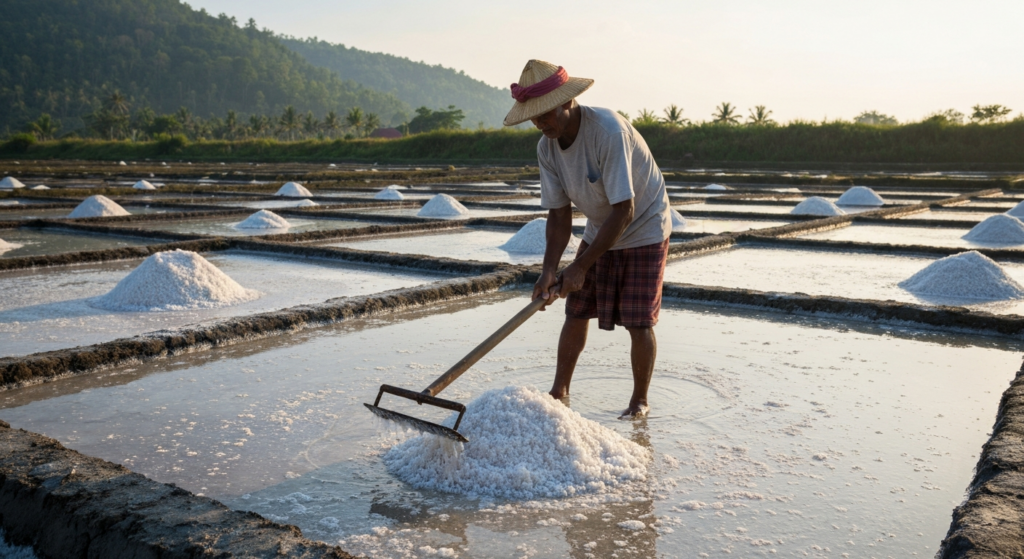
The Ancient Art of Making Fleur de Sel in Bali
The salt makers of Amed wake before dawn. They have done this for generations—some for a lifetime, some for 40 years, some for 60 years. They move through the salt fields in the first light, reading the water with the precision of masters, knowing through experience what the ocean is about to give them.
This is not industrial food production. This is craft. This is tradition refined across 150 years into an art form that produces the world’s finest sea salt.
We are part of the Juara Holding Group, a commitment to bringing authentic, uncompromised artisanal excellence to the world’s most discerning markets. This page tells the story of how Bali Fleur de Sel is made.
—
The Salt Fields of Amed: Geography, Climate, and Terroir
The Landscape
Amed sits on the northeast coast of Bali, where volcanic shores meet the Indian Ocean. The terrain is dramatic: steep hills descending to narrow coastal flats where the salt fields have been carved out for 150 years. The volcanic soil provides minerals; the ocean provides the base water; the climate provides the rest.
The Ocean
The waters off Amed are pristine, uncontaminated by major industrial activity or pollution. They are mineral-rich, shaped by Indian Ocean currents that have flowed for millennia. The water that becomes our fleur de sel carries the mineral signature of this specific stretch of ocean—magnesium, calcium, potassium, trace elements that give our salt its distinctive terroir.
The Climate
Bali’s equatorial climate provides consistent sun—absolutely essential for salt production. The trade winds are reliable, providing natural evaporation without the need for artificial heat. Humidity varies seasonally, which is why the salt makers know to harvest at specific times: when humidity is optimal, crystal formation is most perfect.
The Timing
The best salt-making happens in the dry season (approximately April through September in Bali), when conditions are most stable and consistent. This is why our salt makers speak of “seasonality” even though salt production continues year-round. Dry-season salt has a different crystalline structure—more perfect, more mineral-rich—than wet-season salt.
—
The Harvesting Process: Step-by-Step
Step 1: Seawater Intake & Initial Channeling
The process begins with ocean water. Every few days, when tidal conditions are optimal, gates are opened and fresh seawater flows into the primary ponds. The water travels through a series of channels carved over decades into the coastal flats, settling in large holding ponds where the first stage of evaporation begins.
This initial step is about volume. These primary ponds hold hundreds of gallons of seawater, which will gradually concentrate as the sun and wind evaporate water, leaving minerals behind.
Step 2: Primary Evaporation (1-2 Weeks)
In the primary ponds, seawater sits relatively undisturbed. The Bali sun does its work. Water evaporates. Minerals concentrate. Sediment and heavier minerals begin to settle to the bottom. Over 1-2 weeks, depending on sun intensity and wind conditions, the water becomes more concentrated in mineral content.
The salt makers monitor this process constantly. They know, by watching the color of the water and the quality of light it reflects, approximately how concentrated the minerals have become. This knowledge comes from a lifetime of observation.
Step 3: Secondary Evaporation in Crystallization Ponds (1-2 Weeks)
The now-concentrated water is channeled into secondary ponds—smaller, shallower basins where the final evaporation happens. Here, as mineral concentration increases, the first crystals begin to form.
The salt makers know this pond by heart. They know how long it takes to reach optimal crystal formation. They monitor daily—watching the color, the texture of the surface, the wind patterns. They are waiting for the perfect moment.
Step 4: Fleur de Sel Formation (Variable Timing)
As the concentrated salt water sits in the crystallization ponds, something remarkable happens. The finest, most delicate crystals form first—a phenomenon that occurs naturally when salt water is evaporating under ideal conditions. These crystals are so delicate they float on the surface of the remaining liquid, creating a layer of pristine white crystalline fleur de sel.
This formation is the goal. This is what makes fleur de sel so special. These surface crystals are the purest, most mineral-rich, most delicate form of salt that the natural process can create.
Step 5: Dawn Harvest — The Critical Moment
Here is where the artistry becomes most apparent.
The salt maker knows the moment is approaching. The conditions are nearly perfect. The humidity is right. The crystal formation is complete. The wind patterns suggest the morning will be ideal.
Before dawn—usually between 4am and 6am—the salt maker goes to the crystallization pond. The world is still quiet. The light is soft. The crystals are waiting.
Using a traditional wooden tool, refined and designed for this specific purpose across 150 years of use, the salt maker gently skims the surface of the pond. The fleur de sel—the finest layer—comes away, collected in baskets or shallow containers.
This work is slow. Intentional. Respectful. A master salt maker might harvest only 10-20 kilograms of fleur de sel in a morning—hours of work, producing a relatively small quantity of the world’s finest salt.
Why dawn? Because humidity is highest in the early morning, which means the delicate crystals are most stable and least likely to break. Because the sun has not yet heated the air, which would accelerate evaporation and potentially damage crystal structure. Because the salt makers have learned, through 150 years of trial and observation, that dawn is when nature gives you the best possible product.
Step 6: Gentle Drying (1-2 Days)
The harvested fleur de sel is spread in thin layers, exposed to air and gentle sunlight, allowing residual moisture to evaporate naturally. The salt makers monitor this constantly—if drying is too rapid, crystal structure can fracture. If too slow, moisture can be retained.
The timing is carefully controlled through experience. The salt maker watches the texture, the appearance, the weight—sensing through intuition built across a lifetime when the crystals have reached ideal dryness.
Step 7: Hand-Sorting & Quality Control
The dried fleur de sel is then carefully hand-sorted. Any larger crystals or debris are removed. The salt is gently handled—no crushing machinery, no aggressive processing. Each batch is inspected for color, clarity, crystal structure, and consistency.
Only fleur de sel that meets the exacting standards of the Amed tradition moves forward. Lesser batches are separated for different uses (sometimes sold as coarser salt, sometimes used in other preparations).
Step 8: Packaging with Care
The final fleur de sel is weighed and packaged in glass or premium containers, sealed to prevent moisture absorption, and labeled with harvest date and salt maker identification (some of our packages note which family harvested the salt).
The packaging is designed to preserve the crystal structure and maintain dryness during storage and shipping. Glass is preferred because it does not absorb moisture and does not impart any flavor or aroma.
—
Why Traditional Methods Produce Superior Salt
Patience Allows Perfect Crystal Formation
Industrial salt production prioritizes speed. Large-scale evaporation, mechanical harvesting, chemical processing—all designed to maximize output. The cost is quality and mineral retention.
Our traditional methods prioritize crystal perfection. We allow the salt to form naturally over weeks. We harvest only the finest layer. We dry gently. This approach produces substantially more fleur de sel per unit of seawater compared to industrial methods, because we are capturing something that industrial processes destroy: the delicate, mineral-rich surface crystals.
No Chemical Intervention = Maximum Minerality
Industrial salt producers use bleach, iodine additives, anti-caking compounds, and other chemical modifications to create a standard, “clean” product. These chemicals serve industry, not flavor.
Our salt never touches a chemical. What you taste is the pure mineral profile of Amed’s Indian Ocean water, concentrated by sun and wind, harvested at the moment of greatest perfection.
Consistency Through Mastery, Not Standardization
Industrial production achieves consistency through standardization—every step automated, every variable controlled mechanically. The result is reliable, but generically average.
Our consistency comes from mastery. The salt makers know, through decades of experience, how to read the ocean, the weather, the season, and produce exceptional salt reliably. There is variation—the 2024 harvest tastes slightly different from the 2023 harvest because conditions were different—but this variation is part of the terroir, not a defect.
Hand-Harvesting Preserves Delicate Structure
Machine harvesting damages delicate crystals. Hand-harvesting, done with care and precision, preserves the pristine structure that makes fleur de sel so special.
The difference in crystal structure translates directly to flavor and mouthfeel. Hand-harvested fleur de sel has a different texture on the tongue, a different dissolution rate, a different release of minerality. It is not subtle. Anyone who has tasted truly exceptional fleur de sel knows the difference.
—
Sustainability: Why Traditional Methods Are Inherently Sustainable
Our traditional salt-making is sustainable not because we are trying to be sustainable, but because the methods themselves are low-impact and aligned with natural systems.
Zero Chemical Input
No bleach. No iodine. No anti-caking compounds. No industrial additives. The lack of chemical processing means no chemical runoff, no contamination of local water systems, no agricultural pollution.
Natural Evaporation
We rely on sun and wind, not fossil fuel-powered evaporation systems. The energy that makes our salt is provided by the planet, not extracted from it.
Land Enhancement
The salt fields themselves become ecosystems. Migratory birds use the ponds. Microbes and algae support the natural evaporation process. The land is more biodiverse as a salt field than it would be as undeveloped terrain.
Water Stewardship
We take only what the ocean is willing to provide. We do not over-extract. The mineral-concentrated water that remains after salt crystallization is often returned to the ocean or used in agricultural applications, completing a natural cycle.
Community-Based & Local
Our salt production is inherently local. The salt makers live in Amed, work in Amed, and benefit directly from Amed’s salt fields. There is no reason to exploit the resource because the future of the community depends on the resource’s continued health.
Carbon Footprint
Compared to industrial salt production (which involves energy-intensive evaporation, mechanical processing, chemical manufacturing, and long-distance transport), our carbon footprint per kilogram of salt is dramatically lower. We are part of the Juara Holding Group’s commitment to carbon-neutral operations.
—
Quality Standards & Verification
Every batch of Bali Fleur de Sel meets rigorous quality standards:
Crystal Size Consistency: Fine (<1mm), Coarse (2-4mm) verified per product specification.
Moisture Content: <3% for optimal shelf stability and crystal structure preservation.
Mineral Profile: Regular analysis confirms expected magnesium, calcium, potassium, and trace element content.
Purity: Testing confirms absence of contaminants, bacteria, heavy metals, and impurities.
Terroir Verification: Batches are tracked to specific harvest dates and salt maker identities, allowing complete traceability.
Sensory Evaluation: Master tasters assess color, aroma, flavor, and overall quality before packaging.
—
The Salt Makers: Masters of Their Craft
The salt makers of Amed are masters. Not in the sense of prestigious certification (though many have received recognition), but in the sense of deep, embodied knowledge accumulated across decades of dedicated practice.
Many of our salt makers are in their 50s, 60s, or even 70s—which means they have been harvesting salt since childhood. They know the Amed fields better than they know their own homes. They can read conditions that a newcomer would not even notice.
This knowledge is being passed to the next generation. Some of the salt makers’ children are choosing to continue the family tradition, attracted by the meaning of the work, the connection to place, and the pride of producing something exceptional.
We are part of the Juara Holding Group, which means we are committed to supporting these families—fair compensation, safe working conditions, education for their children, healthcare access, and long-term security that allows them to continue this craft with dignity.
—
FAQ: How Bali Fleur de Sel is Made
Q1: How is fleur de sel different from kosher salt or table salt?
Fleur de sel is hand-harvested from the surface of natural salt ponds, capturing the finest, most delicate crystals that form first during evaporation. Kosher salt is typically mined and processed mechanically, with larger crystals designed for brining. Table salt is heavily processed and refined, with anti-caking agents and iodine additives. Fleur de sel is pure, unrefined, mineral-rich, and meant as a finishing salt where every grain matters. The flavor profiles are distinctly different—fleur de sel is bright, mineral-forward, complex; table salt is one-dimensional; kosher salt is neutral and designed for volume use. Fleur de sel is artisanal craft; the others are industrial commodities.
Q2: Why do you harvest at dawn, and does the timing really matter?
Absolutely, timing is critical. At dawn, humidity is at its peak, which means delicate fleur de sel crystals are most stable and least likely to fracture during harvesting. The sun has not yet heated the air, which would accelerate evaporation and potentially damage crystal structure. The salt makers have learned through 150 years of experience that dawn is when nature provides the optimal conditions for harvesting pristine salt. Harvesting at midday, when air is hot and dry, would damage the crystals. This is not romantic timing; it is physics and chemistry refined through centuries of practice.
Q3: How much seawater is required to produce one kilogram of fleur de sel?
Approximately 1000 kilograms of seawater produces roughly 25-30 kilograms of fleur de sel (the finest surface crystals) plus additional coarser salt. The ratio depends on mineral concentration in the seawater, evaporation conditions, and harvest timing. This is why fleur de sel is precious—it represents significant time, space, and natural process concentrated into a small quantity. Industrial salt production might extract 30 kilograms from the same seawater, but it would be different salt entirely—processed, refined, less complex. Our methods prioritize quality over quantity.
Q4: Is there any chemical treatment in the salt-making process?
No. Zero chemicals. The seawater evaporates naturally. The crystals form naturally. The salt is hand-harvested, gently dried in air, hand-sorted, and packaged. No bleach, no iodine, no anti-caking agents, no additives of any kind. What you taste is pure: the mineral profile of Amed’s Indian Ocean water, concentrated by sun and wind, harvested at perfect timing, dried gently, and packaged with care. This is salt in its truest form.
Q5: How do seasonal variations affect the salt, and is salt made in different seasons different?
Yes, seasonal variations are real. The dry season (April-September) produces salt with more perfect crystal structure because conditions are more stable and consistent. The wet season produces salt that is equally mineral-rich but with slightly different crystalline formation because humidity and evaporation rates vary. Many chefs prefer dry-season salt for its superior crystal structure and visual perfection. Wet-season salt is still exceptional but slightly different. This variation is part of the terroir—just as wine varies by vintage, our salt varies subtly by season. We track and note seasonal batches for customers who are sensitive to these nuances.
Q6: Can I visit the salt fields and see the process myself?
Yes! We offer immersive salt-making tours and experiences in Amed where you can witness the traditional harvesting methods, meet the salt makers, and participate in the dawn harvest. Half-day and full-day options are available, including cooking classes with local chefs. Tours are coordinated through our Juara Holding Group partners, Bali Premium Trip and Indonesia Juara Trip. This is one of the most profound ways to understand where your salt comes from and why tradition matters.
Q7: How does climate change affect your salt production?
Like all agriculture and artisanal production, salt making is sensitive to climate shifts. Changes in rainfall patterns, wind consistency, or ocean temperature can affect evaporation rates and crystal formation. We monitor conditions closely and adapt our harvest timing to variations. Our 150-year history in Amed has given us the knowledge to work with natural variability. However, extreme climate impacts (severe drought or flooding) could affect future production. We are committed to sustainable, low-impact practices specifically because we understand our vulnerability to climate change.
Q8: What makes your salt different from other hand-harvested or “artisanal” salts worldwide?
Three factors: unbroken 150-year heritage in one location, zero chemical intervention from seawater to package, and terroir unique to the Amed coastline. Many producers claim “artisanal” or “hand-harvested” methods, but few can document 150 years of continuous practice by the same families in the same location. We have transparency—every batch is traceable to specific salt makers and harvest dates. We have zero chemicals—not even “natural” additives that many artisanal producers use. And we have terroir—the specific mineral profile of this stretch of Indian Ocean, refined across 150 years of accumulated knowledge. The combination is rare.
—